
Online Coordinates

From Around the world

Apr 102013
 
Malpua

Malpua


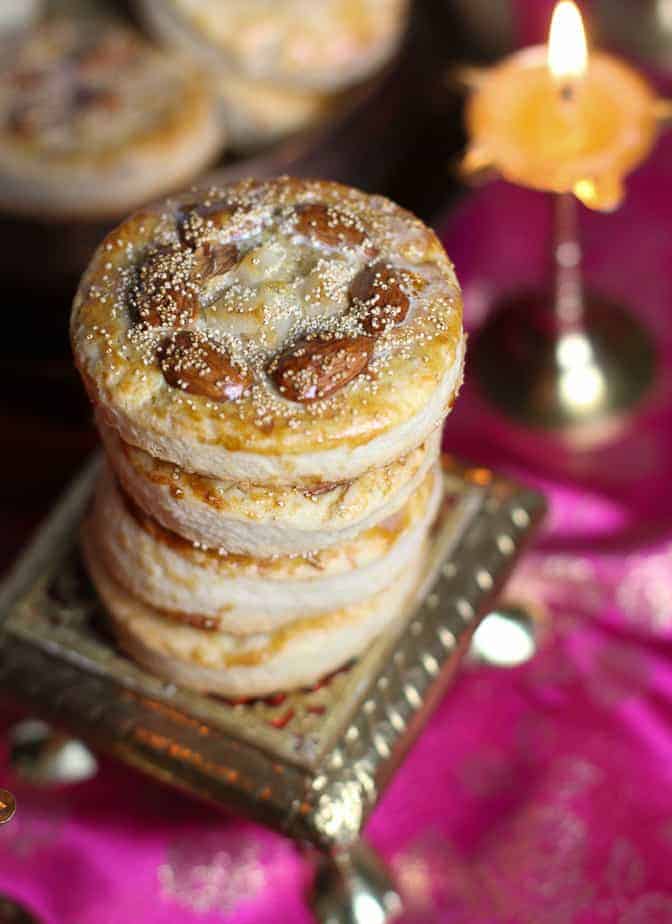
Let’s count the reasons why the Malpua with Banana & Ricotta Cheese is Sinful. It is filled with whole milk Ricotta cheese, it is deep fried in ghee and then dipped in a sugar syrup.  All those things make it sinful. Now let’s see the reasons why it is oh so delicious.  Well.. all the sinful reasons!

For the above mentioned reasons I make this only once a year, on Holi – the festival of colors celebrated to mark the beginning of a new season. It is quite a fun festival to celebrate. It usually starts with making all the food for the festivity in advance as there really is no time to do something later once you start playing. And then a friend lands at your door, you open the door and the friend splashes ‘Gulal’ on you and you do the same. You try your best to not get the homes drenched in color, so when someone knocks, you just go out and play. Then you invite the friend in and share some of the goodies you made. Then you join the friend and go to another friend’s house and the circle of friends keeps getting bigger and happier. There are many stories about why Holi is celebrated, but this is the one I chose to share.

While it has been years since I last went out and played with colors, I still do make one or two traditional dishes, if not all.  It keeps me rooted to where I am from and helps make memories.


There are many traditional recipes to make Malpua,  the Malpua with Banana & Ricotta Cheese  is not one of them. But this is the one I love and this is the one I chose to share.

Malpua


Till we meet next

Stay Blessed

Ansh


Malpua with Banana & Ricotta Cheese

Malpua with Banana & Ricotta Cheese

Ingredients

  • 1 very ripe banana
  • 1 C whole wheat flour
  • 1 C milk
  • 3 tbs ricotta cheese
  • 1/2 tsp cardamom powder
  • ghee for frying
  • 1/4 c water if needed
  • Sugar syrup (chashni)
  • 2 C sugar
  • 2 C water
  • a few strands saffron
  • For garnish : - a few chopped nuts

Instructions

    Make the batter :
  1. In a bowl mash the bananas and then mix everything together.
  2. I usually just use a hand blender and mix. The consistency should be like a pancake batter, so use water if your batter looks thick.
  3. Keep this aside for about an hour.
  4. Make the (sugar syrup)
  5. In a heavy pan, put together sugar, water, cardamom powder and the saffron
  6. Bring to a boil on high heat.
  7. Once it starts boiling, switch to medium heat and let simmer until the syrup thickens – about 15 minutes
  8. At this point do a consistency check -What you want is a single thin string consistency
  9. Stir the syrup with a spoon and then lift the spoon up – lift a tiny amount of the syrup with your forefinger and press the forefinger to your thumb.
  10. Now gradually separate the thumb and the forefinger – if the sugar syrup is of ‘one string’ consistency, you should be able to see a single string between your thumb and forefinger. You do not want a thick string for the Malpua.
  11. Once you achieve this consistency, your sugar syrup is ready.
  12. Add in three to four Tbs of water to this, bring to a quick boil and keep this warm until further use.
  13. The frying
  14. Take a small wok/ medium kadai and heat ghee, you will need about a cup of ghee to heat.
  15. Once it is hot, reduce temperature to medium high and pour 1/4 C of batter into the ghee to fry.
  16. Once it fries up on one side it will be easy to flip over and cook on the other side.
  17. Remove from ghee, immerse in sugar syrup for a couple of seconds, lift up carefully and place on a wire rack or plate, garnish with dry fruits of choice.
  18. Let them rest a few minutes before serving. Best served within a couple of hours of frying. These do not store well.
http://www.spiceroots.com/2013/04/malpua-with-banana-ricotta-cheese/


Apr 052013
 
IMG_4592


Grilled Herb Shrimp

Ina Garten  - The woman who rekindled my passion for cooking.  It was a very boring rainy afternoon in the Keystone  resort.  Boring because it was almost fall but not quite the colorful fall, it was not winter yet and we were at a ski resort doing nothing because it was raining with lightening and thunderstorms.  With the kid being a tiny elementary schooler then, who religiously fell asleep at nap times, I had nothing better to do than flip the TV on and watch something, anything.  This story is from when I first moved to the US and TV as a ritualistic watching had not yet ingrained in my system.

On the screen was this warm personality who was cooking for someone coming over to her house.   And the way she went  about the business of cooking on TV, made me yearn to go back home and be with my mom.  My love for Ina and her books and shows started on that boring, rainy day in Keystone.


Grilled Herb Shrimp

So now you can understand why I am so thrilled about this blog group. It’s all about Ina. The first Friday of every month,  we will  blog one course using an Ina Garten recipe.     Each food blog will feature a recipe on the same day.  So most of the time we won’t know until the last minute if more of us are making the same recipe.  I am thinking one of these days we may all be posting the same recipe ! That would quite interesting! For today’s post I made the Grilled Herb Shirmp.  It’s quick, flavorful and so easy to put together.

Featured below are the wonderful bloggers who are on this journey with me -


Grilled Herb Shrimp – Ina Garten Fridays

Grilled Herb Shrimp – Ina Garten Fridays

Recipe adapted from Food Network

Ingredients

  • 1 clove of garlic
  • 1/4 medium yellow onion
  • 2 Tbs fresh flat-leaf parsley
  • 2 Tbs fresh basil
  • 1 tsp Dijon mustard
  • 1/2 tsp coarse salt
  • a dash of ground pepper
  • 1 Tbs cup olive oil
  • 1 tsp lemon juice
  • 1/2 Lb shrimp peeled and deveined, tails intact
  • Vegetable oil, for grilling

Instructions

  1. In the bowl of a food processor, pulse the onion, garlic, parsley, basil, mustard, salt, pepper, olive oil and lemon juice. You don't need a paste, just a whizz or two to make a mince. Alternately mince the onion, garlic and herbs and mix with the rest of the ingredients.
  2. Add in the shrimp and leave it at room temperature for at least an hour.
  3. Heat a grill or a grill pan over medium-high heat.
  4. Brush the rack or pan with vegetable oil to prevent the shrimp from sticking.
  5. Skewer 5 to 6 shrimp on a skewer
  6. Grill the shrimp on each side, until opaque and lightly charred, about 1 1/2 minutes.
http://www.spiceroots.com/2013/04/grilled-herb-shrimp-ina-garten-fridays/


 Posted by on April 5, 2013 at 1:47 PM
Mar 292013
 
Tandoori spiced Salmon

Tandoori Spiced Salmon with kale and black rice


It is a bitter sweet moment, writing this post today. Today is the last post of the Power Foods Blogging Group. I learned a lot on this journey of 38 power foods with the blog group. The stories from each one of the bloggers kept me entertained and the facts about power foods kept me amazed. There was so much about these foods that I did not know and there still is so much to learn. The blogging group helped me stop and take notice and ask the food, “So what are YOU going to help me with?”


Tandoori spiced Salmon

As we wind up this journey and get ready to embark on another one, I do have one more power food recipe for you.  It is the Indian version of pan roasted, Tandoori Spiced Salmon With Black Rice and it is a no fuss recipe.   Just to make life easier for my friends who keep complaining that they have to go with a huge spice list to buy everything they need to make my dishes, I have for once used a ready mix of Tandoori spices. I can see you grinning ear to ear.  Yes,  it is really as simple as that. And as for cooking black rice, you can use this method or follow your own method.

For well researched health benefits of Salmon read the article on WHF. 

And for one last time, here are the fellow bloggers who were in this journey with me, discovering power foods and sharing stories and recipes.:-

Jeanette at jeanetteshealthyliving ; Martha at Simply Nourished Living ; Mireya at Myhealthyeatinghabits ; Alyce at More time at the table ;  Minnie at thelady8home.com ; Casey at  Sweetsav  .


Tandoori Spiced Salmon With Black Rice

Tandoori Spiced Salmon With Black Rice

Ingredients

  • 2 Fillets Wild caught Alaskan Salmon
  • 1/2 C Black Rice cooked
  • 1 C Chopped Kale
  • 1 tsp Tandoori Masala ( I recommend using Shaan Brand)
  • 1/2 tsp lemon juice
  • 1 tsp olive oil
  • 1/2 tsp salt
  • 1/2 tsp ginger paste
  • 1/2 tsp garlic paste
  • oil spray

Instructions

  1. Mix in the lemon juice, ginger, garlic, salt and tandoori Masala.
  2. Marinate the fish pieces in this mix for about 15 minutes, ensuring to coat all both the sides of the fish.
  3. Heat a skillet on medium high heat and spray with a little oil.
  4. Cook the marinated fish for 3- 5 minutes on each side depending on how you like it cooked.
  5. Mix in the olive oil with the kale and massage it a little.
  6. Serve warm black rice with the tandoori salmon along with the massaged kale.

Notes

You can shop up the cooked salmon and mix everything together for a salad for work.

The link to the shaan brand for Tandoori spice is reference only. You can buy it cheaper at any Indian grocery store.

http://www.spiceroots.com/2013/03/tandoori-spiced-salmon-with-black-rice/


Feb 272013
 
IMG_4395

Lavash Crackers

The Armenian-style lavash crackers have been on my mind ever since the Daring baker’s challenge was announced. Crisp, with a touch of sesame or nigella or poppy seeds they are a delicious accompaniment to any jam, jelly or cheese. In my case, It had to be the Jalapeño- raspberry jelly that I made during the fall. Tart, sweet, fiery Jaloberry jelly as my daughter calls it, was waiting to be devoured. So I went ahead and made a batch of the crackers.

I could have chosen one of the many recipes suggested by Sarah from All Our Fingers in the Pie, who was our February 2013 Daring Bakers’ host. She challenged us to use our creativity in making our own Crisp Flatbreads and Crackers.

I chose this recipe for the simplicity and ease as my daughter wanted to bake along. Can’t scare her with a huge list of ingredients, can I?  she would have run and never wanted to bake again. So simple and easy it was and in no way simple on flavors.  These babies pack a punch!

Lavash Crackers

Lavash Crackers

Ingredients

  • 1-1/2 cups bread flour
  • 1/2 teaspoon salt
  • 1/2 teaspoon instant yeast
  • 1 tablespoon raw sugar
  • 1 tablespoon olive oil
  • 1/2 cup water
  • sesame /poppy /Nigella seeds for topping

Instructions

  1. Line two large baking sheets with parchment paper.
  2. In the mixing bowl of your stand mixer, add the flour, salt, yeast, sugar, oil and water. stir until the dough comes together, then knead for about 3 minutes.
  3. shape into a ball and place the dough into a bowl, cover with plastic wrap and allow to rise for about an hour
  4. Preheat the oven to 350F.
  5. Divide the dough into two parts. roll out each part as thin as possible and then cut it into strips.
  6. Sprinkle the spices/ seeds and bake for 15 - 20 minutes until browned. Allow to cool before munching on.
http://www.spiceroots.com/2013/02/lavash-crackers/

Bhavna Kalra liked this post
 Posted by on February 27, 2013 at 11:22 AM
Feb 242013
 
Feb13

All Kinds of Croissants

The simple act of reaching out for a croissant, savoring its delicious layers, inhaling the deep aroma is a soul satisfying experience. Making a good croissant and sharing it recreates that experience and enhances it manifolds.

Flour, sugar, butter, milk, water, salt, yeast. That’s really all you need to make these fabled bites of a Viennoiserie goodness. The perfect crunch of top, the buttery layers inside and one little bite into it transports you to a place from where you don’t want to return.

Making a Croissant takes just two things – 1) Great quality ingredients  2) Love

To say that Croissants are a labor of love is to put it mildly. You wait for the dough to be just right, you check the temperature of the butter constantly, you laminate and freeze and then you keep an eagle eye on them while they are baking. And then you share them! My dears, the day you share a well made croissant with someone, it can only mean two things -

1) You love them – A LOT

2) 2) You are Enlightened and don’t worry about earthly things any more. There is no other reason you would share this with anyone.


Croissants from scratch is the second bread we are doing together as part of Project “We Knead to Bake”

Aparna provided us with a tried and tested recipe that really made our project easy. The detailed step by step instructions, worked like a charm. I would have liked to say that my Croissants turned out awesome the very first time, if I didn’t know for a fact that if Aparna had not taken the time and effort to make a Croissant making guideline, I would still have been looking for the perfect recipe.

 The original source of the recipe was  Jeffrey Hamelman’s classic croissant at Finecooking.com. There really isn’t anything much that I changed from Aparna’s recipe except that I had to use some extra milk to make the dough pliable, so I am taking the liberty and using her recipe in my blog post along with instructions. For a detailed understanding of how it all comes together, watch the audio tutorial on the Finecooking.com website. Also hop on over to Aparna’s blog for a detailed step by step instruction and do check  Niv’s Blog for a panfusine version that she she named Pain au Poornam. Also check out this video to get a fair idea of what you are getting yourself into.

For more Croissant posts check out  Aparna’s “We Knead to Bake “ and these croissants are also being Yeast spotted.


Croissants – We Knead to Bake

Serves: 15

Serving Size: 1

Croissants – We Knead to Bake

Ingredients

    For the dough
  • 4 cups all-purpose flour, and a little more for dusting/ rolling out dough
  • 1/2 cup plus 2 tbsp cold water
  • 1/2 cup plus 2 tbsp cold milk [ I had to add two more Tbs]
  • 1/4 cup granulated sugar
  • 40gm soft unsalted butter
  • 1 tbsp plus scant 1/2 tsp instant yeast
  • 2 tsp salt
  • For the butter layer
  • 250 gm cold unsalted butter
  • For final egg/milk wash
  • 1/4 cup of cold milk / 1 egg for egg wash / a mixture of 1/4 C powdered milk and a little water to brush on top of Croissants before baking

Instructions

    Day 1
  1. Combine all the ingredients for the dough in the bowl of a stand mixer fitted with the dough hook. You can also use a food processor with the plastic blade, or do this by hand.
  2. Mix everything on low speed for 3 minutes, scraping the sides of the mixing bowl once if necessary. Then mix further on medium speed for 3 minutes. Lightly flour a 10-inch pie pan or a dinner plate. And place the ball of dough on this.
  3. Gently shape the dough into a flat ball by pressing it down before storing it in the fridge, this makes rolling out next morning easier. Lightly dust the top of the dough with flour and wrap well with plastic so it doesn’t dry out. Refrigerate overnight.
  4. Day 2
    Make the butter layer
  5. The next day, cut out 2 pieces of parchment or waxed paper into 10” squares each. Cut the cold butter into 1/2-inch-thick slabs. Place these pieces on one piece of parchment/ waxed paper so they form a 5- to 6-inch square. Cut the butter further into pieces as required to fit the square. Top with the other piece of parchment/ waxed paper.
  6. Using a rolling pin, pound the butter with light, even strokes. As the pieces begin to stick together, use more force. Pound the butter until it flattens out evenly into a square that’s approximately 7-1/2”. Trim the edges of the butter to make a neat square. Put the trimmings on top of the square and pound them in lightly with the rolling pin. Refrigerate this while you roll out the dough.
  7. Laminate the dough
  8. Unwrap and lay the dough on a lightly floured work surface. Roll it out to a 10-1/2-inch square, and brush off the excess flour. Take the butter out from the refrigerator —it should be cold but pliable. If it isn’t refrigerate it till it is. This so that when you roll out the dough with the butter in ti, neither should it be soft enough to melt, or hard enough to break. Unwrap the butter and place it on the square of dough in the centre, so that it forms a “diamond” shape on the dough.
  9. Fold one flap of dough over the butter toward you, stretching it slightly so that the point just reaches the middle of the butter square. Bring the opposite flap to the middle, slightly overlapping the previous one. Similarly repeat with the other two so that the dough forms an envelope around the butter. Lightly press the edges together to completely seal the butter inside the dough to ensure the butter doesn’t escape when you roll out the dough later.
  10. Lightly flour the top and bottom of the dough. With the rolling pin, firmly press along the dough uniformly to elongate it slightly. Now begin rolling instead of pressing, focusing on lengthening rather than widening the dough and keeping the edges straight.
  11. Roll the dough into an 8” by 24” rectangle. If the ends lose their square shape, gently reshape the corners with your hands. Brush off the excess flour. Mark the dough lightly equally into three along the long side. Using this as a guideline, pick up one short end of the dough and fold 1/3rd of it back over the dough, so that 1/3rd of the other end of dough is exposed. Now fold the 1/3rd exposed dough over the folded side. Basically, the dough is folded like 3-fold letter before it goes into an envelope (letter fold). Put the folded dough on a floured baking sheet, cover with plastic wrap, and freeze for 15 to 20 minutes to relax and chill the dough.
  12. Repeat the rolling and folding, this time rolling in the direction of the two open ends (from the shorter sides to lengthen the longer sides) until the dough is about 8” by 24”. Once again fold the dough in thirds, brushing off excess flour and turning under any rounded edges or short ends with exposed or smeared layers. Cover once again with plastic wrap and freeze for another 15 to 20 minutes.
  13. Roll and fold the dough exactly in the same way for the third time and put it baking sheet. Cover with plastic wrap, tucking the plastic under all four sides and refrigerate overnight.
  14. Day 3
    Divide the dough
  15. The next day, unwrap and lightly flour the top and bottom of the dough. Cut the dough along the longer side into halves. Cover one half with plastic wrap and refrigerate it while working on the other half.
  16. “Wake up the dough up” by pressing firmly along its length with the rolling pin. Don’t widen the dough but simply begin to lengthen it with these first strokes. Slowly roll the dough into a long and narrow strip, approximately 8” by 22”. If the dough sticks as you roll, sprinkle with flour.
  17. Once the dough is about half to two-thirds of its final length, it may start to resist rolling and even shrink back. If this happens, fold the dough in thirds, cover, and refrigerate for about 10 minutes; then unfold the dough and finish rolling.
  18. Lift the dough an inch or so off the table at its midpoint and allow it to shrink from both sides and prevent the dough from shrinking when it’s cut. Check that there’s enough excess dough on either end so that when you trim the edges to straighten them, you have a strip of dough that is 20’ inches long. Now trim the edges so they’re straight.
  19. If you’re good at “eyeballing” and cutting the dough into triangles, then forget the measuring rule, marking and cutting instructions. Otherwise, lay a measuring rule or tape measure lengthwise along the top length of the dough. With a knife, mark the top of the dough at 5-inch intervals along the length (there will be 3 marks in all). Now place the rule or tape measure along the bottom length of the dough. Make a mark 2-1/2 inches in from the end of the dough. Make marks at 5-inch intervals from this point all along the bottom of the dough. You’ll have 4 marks that fall halfway between the marks at the top.
  20. Make diagonal cuts by positioning the yardstick at the top corner and the first bottom mark. Use a pizza wheel/ pie wheel or a bench scraper and cut the dough along this line which connects each top mark to the next bottom mark and then back to the next top mark and so on. This way you will have 7 triangles and a scrap of dough at each end.
  21. Shape the croissants
  22. Now work with one piece of triangular dough at a time. Using your rolling pin, very lightly roll (do not make it thin but only stretch it slightly) the triangle to stretch it a little, until it is about 10” long. This will give your croissants height and layers. You can stretch it by hand too, but if you don’t have the practise, your stretching could be uneven.
  23. Using a sharp small knife, make a 1/2- to 3/4-inch-long notch in the centre of the short side of each triangle. The notch helps the rolled croissant curl into a crescent.
  24. Place the triangle on the work surface with the notched side closest to you. With one hand on each side of the notch, begin to roll the dough away from you, towards the pointed end.
  25. Flare your hands outward as you roll so that the notched “legs” become longer. Roll the triangle tight enough but not too tight to compress it, until you reach the “pointy” end which should be under the croissant.
  26. Now bend the two legs towards you to form a tight crescent shape and gently press the tips of the legs together (they’ll come apart while proofing but keep their crescent shape).
  27. Shape all the triangles like this into croissants and place them on a greased or parchment lined baking sheet leaving as much space between them as they will rise quite a bit.
  28. Proof the croissants
  29. Brush the croissants with milk (or a mix of water and powdered milk or an egg wash).
  30. Refrigerate the remaining milk/ egg wash for brushing the croissants again later. Place the croissants in a cool and draft-free place (the butter should not melt) for proofing/ rising for about 1 1/2 to 2 hours. They might need longer than 2 hours to proof, maybe as much as 3 hours, so make sure to let croissants take the time to proof. The croissants will be distinctly larger but not doubled in size. They’re ready if you can see the layers of dough from the side, and if you lightly shake the sheets, the croissants will wiggle.
  31. Bake the croissants
  32. Just before the croissants are fully proofed, pre-heat your oven to 400F. Brush the croissants with a second time, and place your baking sheets on the top and lower thirds of your oven.
  33. Bake them for about 15 to 20 minutes till they’re done and golden brown on top and just beginning to brown at the sides, turning once while they are baking. Cool the croissants on the baking sheets on racks.
  34. Best Served warm
http://www.spiceroots.com/2013/02/croissants-from-scratch-we-knead-to-bake2/

 Posted by on February 24, 2013 at 9:55 PM
Feb 032013
 
Nan-e-Barbari - Persian bread

I have been missing home, a lot, lately. That is one of the reasons why you are and will be seeing a lot of bread / Naan/ Indian bread related posts on Spiceroots. There is something in those not so distant mountains that I see from my kitchen window that speaks of home to me. Its almost hypnotic. How they change from the time the first rays of sun touch them to the time the sun hides behind them almost feels like a conversation. I do feel very blessed to live in Colorado. It feels like home and yet makes me miss home. Ironic. I know.

I chanced upon this bread in the latest issue of Food and Wine and immediately knew I will make it soon. I leafed through the magazine to get my daily dose of food porn, but I kept coming back to the pictures of this bread.

There was an instant connection, almost a pull. Something about the bread was familiar. When I read the recipe, I knew what the connection was. The Bread uses a roomal – mixture of flour, water , oil & sugar for that exquisite color and texture. And that is what the local Kandur ( bread maker) in Kashmir uses when he is making the special breads with rogan – very similar to roomal.

 So I kept the magazine down and set to work. This bread had to be made and made immediately. The whole process of making this bread was nostalgic. And I am glad to say the Nan-e-Barbari has reached the coveted place of “myfavorite bread” in Miss S’s books! That is no mean feat!


This bread is also heading over to Yeast Spotting.

Nan-e-Barbari – Persian Bread

Serves: 2 breads

Nan-e-Barbari – Persian Bread

Recipe slightly adapted from Food and Wine Magazine.

Ingredients

    To make the dough
  • 2 1/4 tsp active dry yeast
  • 4 cups all purpose flour Plus some more for kneading
  • 2 tsp salt
  • 2 cups lukewarm water
  • To make the Roomal
  • 1 tsp oil
  • 1 Tbs all purpose flour
  • 1 tsp sugar
  • Final touches:
  • 1 tbs Nigella seeds (optional )
  • 1 tbs sesame seeds (optional)
  • some extras:
  • 1tsp oil

Instructions

  1. Add the yeast to water and let it bubble up.. about 5 minutes
  2. Mix the salt into the 4 cups of flour and add to the yeast mix.
  3. Knead to a very smooth dough ( 6 - 7 minutes in a stand mixer) ( If kneading by hand - knead until your dough can stand the window pane test ; If the dough is a little sticky, apply flour to your hands and keep kneading... )
  4. Oil a bowl and put the dough in it, cover and let it rise for an hour, until double in volume.
  5. Next punch the dough down and divide into two parts. cover and let it rise again.
  6. While the dough is rising this time, make the roomal.
  7. Combine the flour, oil , sugar, with half a cup of water and mix it all in and cook it on low heat until it thickens. cover and let it cool.
  8. Preheat the oven to 450*F.
  9. Working each part of the dough separately, shape the dough into a rectangle and put it on a well oiled baking sheet.
  10. Make the ridges in the shaped dough, apply half of the roomal paste, sprinkle half of the sesame, nigella on it and bake for 15- 18 minutes.
  11. Repeat wit the second part of the dough!

Notes

http://www.spiceroots.com/2013/02/nan-e-barbari-persian-bread/

Ruchi Angrish liked this post